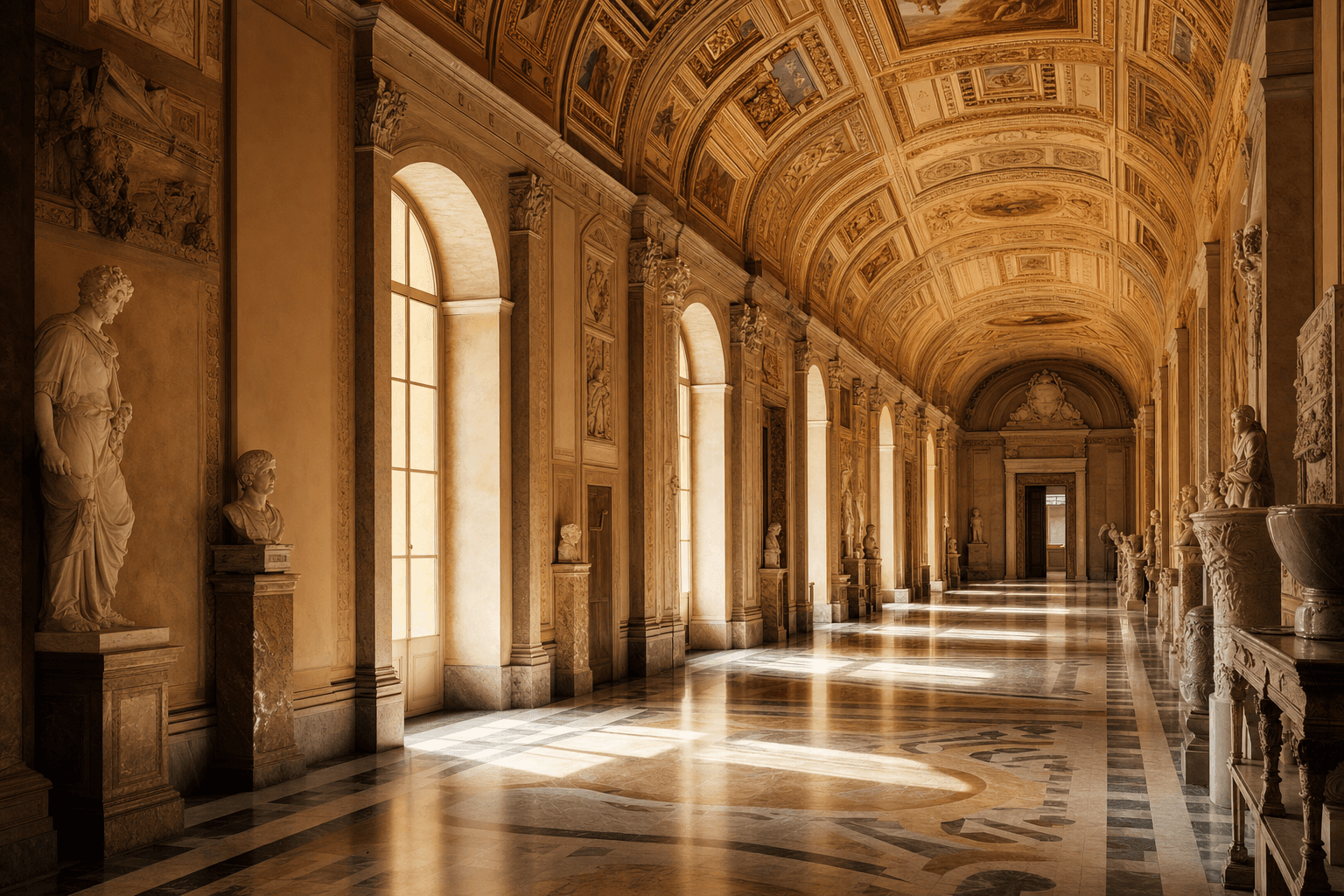
Most disappointing mornings at the Vatican are not caused by the crowds. They are caused by three decisions made weeks earlier: where the ticket was bought, whether the dress code was taken seriously, and which entry slot was chosen. Get those three right and the 7 kilometres of galleries leading to the Sistine Chapel behave very differently. This guide covers Vatican Museums tickets, the dress code that turns visitors away at the door, and the timing that changes what you see — with one piece of good news attached: after the Jubilee year, booking is the easiest it has been in three years.
The one ticket rule that matters
There is exactly one official sales channel for the Vatican Museums (Musei Vaticani, the papal collections inside Vatican City): tickets.museivaticani.va. The official site itself warns visitors about lookalike domains — pages that copy the layout, rank well in search results, and resell the same entry at a markup. If the address in your browser is anything other than the official one, you are paying someone else's commission.
The current price is straightforward: €20 for an adult ticket, plus a €5 online booking fee — €25 in total. That surcharge is what the Vatican calls its "skip the line" fee, and it is not optional if you want a reserved time slot; it is the price of not queueing on Viale Vaticano, the street that runs along the museum walls. The adult rate was reported as raised from €17 during 2026, so older guidebook figures will read low.
On the booking window: reserve as soon as your dates are fixed, and choose a specific date and time rather than a flexible option. This is also where the post-Jubilee context helps. Visitor numbers in January and February 2026 ran roughly 30% below the same months in 2025, and availability has loosened accordingly. Two or three weeks ahead is now usually comfortable for a weekday morning, where the same request would have been tight in 2024.
The dress code, taken seriously
The Vatican dress code is not a museum quirk. The complex ends in the Sistine Chapel, a consecrated chapel where the conclave elects the pope, and the same rules apply in St. Peter's Basilica. The staff at the entrance apply them consistently, and they do it before you have passed security — not after.
What is required:
- Shoulders covered. No sleeveless tops, no tank tops, no spaghetti straps.
- Knees covered. Shorts, short skirts and short dresses are refused; trousers, longer skirts and midi dresses are fine.
- No bare midriffs, and no clothing with slogans or imagery that would read as provocative in a church.
- Hats off inside the Basilica.
The practical solution is a large scarf or pashmina in your bag — light enough to carry in July, wide enough to cover shoulders or wrap as a skirt. Vendors sell them outside the entrance at tourist prices, which is a poor reason to arrive unprepared. Trousers that convert from shorts are the other reliable answer for summer.
Inside the Sistine Chapel two further rules hold: no photography of any kind, and silence. Elsewhere in the museums, photography without flash is permitted. The custodians who ask for quiet in the Chapel are not managing crowd noise for its own sake — they are protecting a working place of worship. Visitors who understand that in advance tend to have a better twenty minutes under the ceiling than those who spend them negotiating with a guard.
When to enter
The first slot of the morning
The single most consequential choice you make is the entry time. The Vatican Museums admit visitors along one broad route, and that route funnels toward the Sistine Chapel. Enter at midday and you arrive in the Chapel inside a slow-moving mass that has been accumulating since opening. Enter with the first slot of the morning and you reach the same room with a fraction of that pressure — sometimes enough space to stand still, look up, and let your eyes adjust to Michelangelo's ceiling before the acoustic hum builds.
The same logic applies backwards through the galleries. The Gallery of Maps, the Raphael Rooms, the Candelabra Gallery: all of them are legible in the first hour and difficult later. Early entry also spares you the hottest part of the day in rooms with limited air circulation, which matters from June through September.
Getting there is simple. Take Metro Line A to Ottaviano–San Pietro, then walk roughly 500 metres to the entrance on Viale Vaticano. Allow more time than the map suggests for a first-slot arrival: the walk is short, but the security queue forms before opening, and a reserved time is a time to be inside the door, not a time to leave your hotel.
Days to avoid, days to prefer
The weekly rhythm is predictable once you know it.
- Wednesday mornings bring the papal general audience to St. Peter's Square, which draws large numbers into the whole Vatican area. The museums themselves can be quieter once the audience begins, but the approach, the metro and the square are congested.
- Mondays tend to be busy because several other major Roman museums are closed at the start of the week, and visitors redirect here.
- Tuesday, Thursday and Friday mornings are generally the calmest weekday options.
- The last Sunday of the month is the well-known trade-off: admission is free, and the crowds are proportionate. Free entry cannot be reserved in advance, so you exchange a €25 ticket for a long queue and a dense route. For a first visit, the paid weekday morning is the better use of your time. Since Sunday arrangements can change, confirm the calendar on the official site before planning around it.
All of this sits inside a broader picture worth understanding, which is why 2026 is an unusually good year to visit — the pilgrimage surge has passed, and the city's most pressured sites have room to breathe again.
What "skip the line" actually skips
The €5 booking fee buys you a reserved entry time. It does not buy you an exemption from security. Every visitor passes through a metal detector and bag screening, and at peak hours that queue is the real one. A pre-booked ticket means you join a shorter, faster-moving line rather than the general-admission queue along the wall — a meaningful difference in August, less dramatic on a quiet February morning.
Plan for the screening rather than being surprised by it:
- Large backpacks, luggage, tripods and umbrellas are not permitted in the galleries and must be left in the cloakroom, which is free.
- Travel light. A small bag passes without discussion; a hiking pack means a detour to the cloakroom and back before you begin.
- Water bottles are generally allowed, and refilling is possible in the courtyards.
If you are carrying anything unusual, check the official site before you arrive rather than at the metal detector. Budget fifteen to twenty minutes between your reserved time and the moment you are actually walking into the first gallery — that margin is what makes an early slot work as intended.
Museums, Chapel, Basilica: three different visits
Visitors often assume one ticket covers everything inside the walls. It does not.
- Your Vatican Museums ticket covers the museum complex — the classical sculpture, the Pinacoteca picture gallery, the Egyptian and Etruscan collections, the map and tapestry galleries, the Raphael Rooms — and ends with the Sistine Chapel, which is the final room of that route, not a separate site.
- St. Peter's Basilica is a separate visit with its own entrance from St. Peter's Square, and admission to the church itself is free. The dome climb and the Vatican Grottoes have their own arrangements.
The practical consequence is that the museums and the Basilica are two half-days unless someone sequences them for you. This is where the guided version earns its place: our early-morning Vatican tour is built around an early slot and an art historian who edits a 7-kilometre collection down to what one morning can hold, then connects the Chapel to St. Peter's without doubling back through the crowds. It suits first-time visitors and anyone who would rather understand thirty works than walk past three hundred.
Beyond the standard route
One detail worth knowing when you weigh a guided visit against a standard ticket: Eterno's guides hold official accreditation from the Vatican Museums. It is a formal credential, issued by the museums themselves, and it carries a practical consequence — accredited guides can arrange visits to sections of the complex that are not open to general-admission ticket holders.
We deliberately keep that description general. Which areas are available, and when, depends on the museums' own schedule, on conservation work and on institutional use, and no honest operator can promise a specific room months ahead. What the accreditation does mean is that the request is possible at all: a standard online ticket admits you to the standard route, and nothing beyond it.
For many visitors the standard route is exactly right, and a well-timed €25 ticket with a scarf in the bag is a complete and satisfying morning. The case for going guided is narrower and worth stating plainly: it holds if you want the early slot handled, the collection interpreted by an art historian rather than an audio track, and the option — availability permitting — of seeing something the general ticket does not reach. If that is the visit you have in mind, the accredited route is the only one that offers it.
For an afternoon rather than a morning, our Vatican Museums & wine tasting tour takes a different shape: the essential galleries and the Sistine Chapel with a guide, followed a few minutes later by a seated Italian wine tasting nearby. It is the same accredited access to the collection, arranged around a slower, later start.