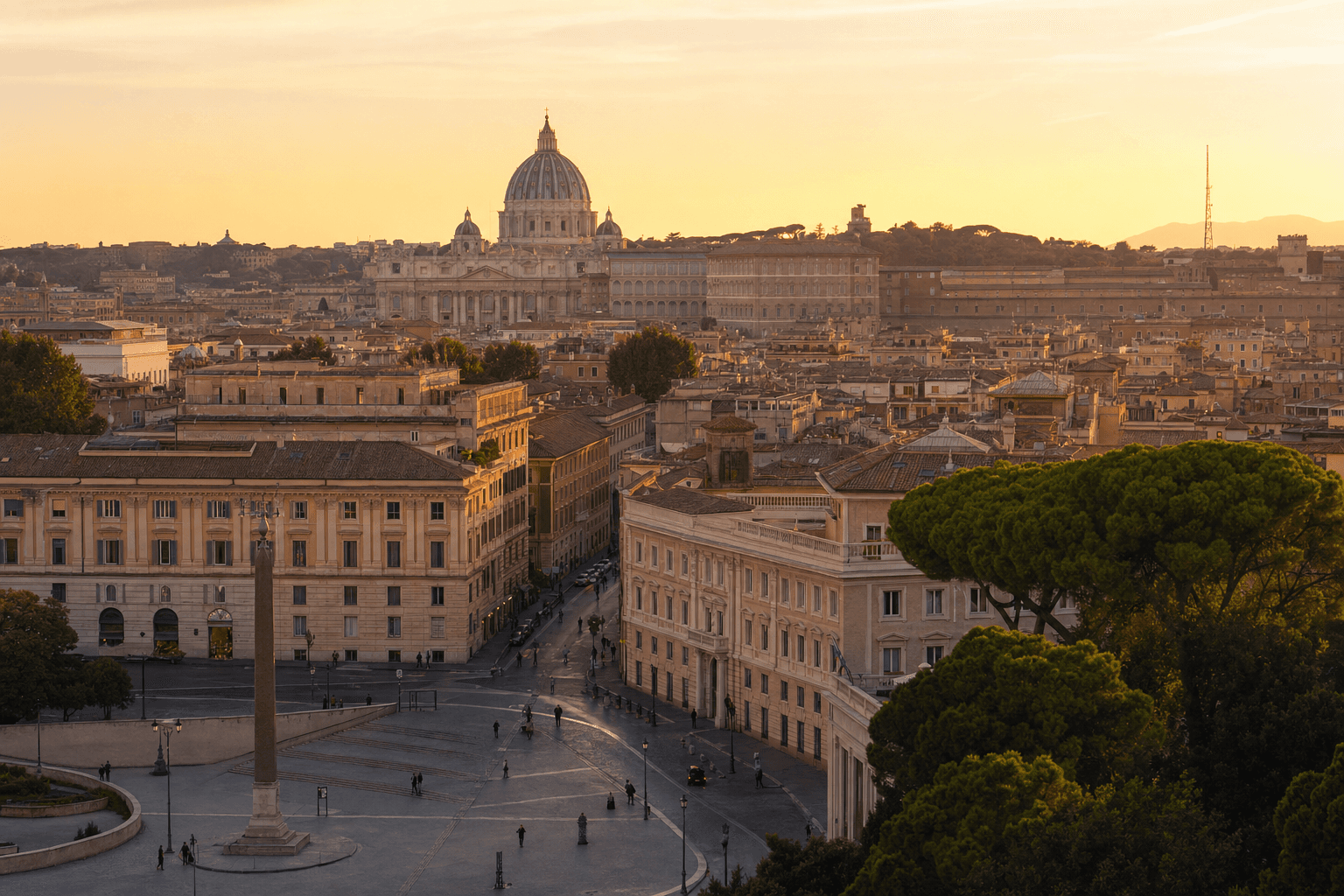
Rome spent 2025 hosting the largest single gathering in its modern history. The Jubilee — the Catholic Church's holy year, celebrated roughly every 25 years — drew an estimated 33 million travelers and pilgrims, and it closed officially on January 6, 2026. The assumption most people make about the year that follows is that the city will be either exhausted or still overrun. The evidence points the other way: visiting Rome in 2026 means arriving after the infrastructure was rebuilt and after the crowds went home. That combination does not happen often, and it will not repeat until the next holy year in 2033.
The year the crowds went home
The post-Jubilee drop is not a feeling; it is measurable. Visitor numbers at the Vatican Museums in January and February 2026 ran roughly 30% below the same months in 2025. That is the single clearest indicator available, because the Vatican was the gravitational center of the holy year: pilgrims who came for the Holy Doors came through those galleries. When the doors closed, the flow reversed.
The hotel market tells the same story from a different angle. Through 2025, rates carried a Jubilee premium — the surcharge a city applies when demand is guaranteed. That premium is gone, and rates have softened back toward normal seasonal patterns. For the traveler this is not a discount; it is a return to what Rome costs in an ordinary year, after a year that was anything but ordinary.
So the question people keep asking — is Rome crowded in 2026 — has an unusually precise answer. It is less crowded than it was in 2025, and it is a materially better-functioning city than it was in 2023. Rome after the Jubilee is not a city recovering from an event. It is a city that spent five years preparing for one, finished the work, and then watched the audience leave.
What the Jubilee left behind
Holy years leave physical traces. The 1600 Jubilee reshaped Baroque Rome; the 2000 Jubilee gave the city the Auditorium and a generation of restorations. The 2025 holy year worked at similar scale — widely reported as more than 330 separate projects — and by 2026 those works are finished and in daily use rather than fenced off behind scaffolding.
A rebuilt, walkable city
The most consequential change is underfoot. Piazza Pia, inaugurated in December 2024, sank a major traffic artery below ground and replaced it with what is now the largest pedestrian area in Rome, with a reported capacity of up to 150,000 people. It joins Castel Sant'Angelo — Hadrian's mausoleum, later a papal fortress — to St. Peter's Basilica in a single uninterrupted walk along the axis of Via della Conciliazione. Where travelers once waited at a traffic light beside four lanes of cars, they now cross open stone.
The same logic was applied across the historic center: pedestrian zones expanded, facades cleaned of decades of exhaust, piazzas resurfaced, metro stations and rolling stock upgraded. The cumulative effect is subtle for a first-time visitor and startling for anyone returning after five years. Rome has always been a walking city by temperament; it is now one by design as well. The pedestrian city the Jubilee built deserves an article of its own, and it will get one — the short version is that itineraries which used to require a taxi now reasonably do not.
The sealed Holy Doors
The holy year's central ritual has ended. The four Holy Doors — at St. Peter's, St. John Lateran, St. Mary Major and St. Paul Outside the Walls, the city's four papal basilicas — were resealed in the first week of January 2026 and remain bricked shut until 2033. Passing through them, the devotional act that defined 2025 for millions of pilgrims, is no longer possible.
What this removes is a rite, not a destination. All four basilicas remain open, and all four are extraordinary independently of the holy year: St. John Lateran is the cathedral of Rome and the oldest basilica in the West; St. Paul Outside the Walls holds the tomb of the apostle beneath a nineteenth-century reconstruction of astonishing scale. St. Mary Major, which preserves fifth-century mosaics in its nave, has also become the burial place of Pope Francis, interred there in April 2025. Entry is free and the basilica sits a short walk from Termini station, reachable directly by Metro line A.
The practical consequence for 2026 is straightforward: the pilgrimage circuit that concentrated enormous numbers into four buildings has dissolved, and those buildings are quiet again. What remains of Christian Rome after the Jubilee is a subject we will return to separately.
Planning the trip: what visiting Rome in 2026 asks of you
A calmer city rewards planning rather than replacing it. Two or three decisions, made before departure, determine most of the experience.
When to go
March is the strongest month of the first half of the year: mild, long-lit, and still ahead of the spring wave. Late October and the first half of November are its autumn equivalent — warm stone, low sun, thin crowds, and the vintage already in the cellars of the surrounding hills.
Easter falls in early April 2026 and will bring a surge, though a modest one by Jubilee standards, concentrated around the Vatican and the papal basilicas over the Easter Triduum. Plan around those specific days rather than avoiding the season.
August remains the month to treat with caution. Heat in the historic center is severe, the stone holds it into the night, and many family-run restaurants and specialist shops close for two or three weeks. Rome in August is possible; it is simply not Rome at its best.
The two bookings you cannot improvise
Everything else in Rome can be decided the morning of. These two cannot.
The Colosseum. Entry is timed and capacity-controlled, and tickets are nominative — issued in a named person's name. We set out the mechanics in detail in how Colosseum tickets actually work in 2026. If you would rather have the archaeology explained on site by someone who can read the building, our Colosseum, Roman Forum & Palatine Hill tour covers the full monumental center in one continuous visit.
The Vatican Museums. Even at 2026 volumes, the Sistine Chapel concentrates the day's visitors into a single room, and the hour you choose matters more than the day. The reasoning is laid out in Vatican Museums tickets and timing. For travelers who want the galleries before the general flow arrives, our early-morning Vatican tour is built around that window.
One day or several
Rome does not surrender to a single day, but a single day is often what a traveler has — a stopover, a cruise call, a business trip with one free morning. In that case the constraint is not walking distance; it is the sequencing of timed entries, which is precisely what goes wrong when the day is improvised. Rome in a Day exists for exactly this: the Colosseum, the Vatican and the historic center arranged so that the transitions do not consume the day.
With three or four days the shape changes entirely. One day for the ancient city, one for the Vatican, and then — the real argument for a longer stay — days without monuments in them at all: neighborhoods, markets, a single museum taken slowly, an afternoon outside the city walls.
Beyond the landmarks
The Colosseum and the Vatican are the reasons most people come, and they are not the reasons most people remember. In a year with fewer visitors, the city's second and third registers become accessible again in a way they were not in 2025.
Evening walking is the first of them. Rome after dark, once the day-trip coaches have left, is a different city: the Pantheon's portico under floodlight, Piazza Navona emptied to its fountains, the Capitoline steps in silence. It costs nothing and asks only that you eat later than you would at home. We will map a proper route in a future piece.
Underground Rome is the second. Beneath the modern street level lie mithraea, insulae, early Christian houses and the diverted course of ancient waterways — the layered city that explains why the surface looks the way it does. Access is site by site, often by reservation, and worth the administrative effort; another subject we intend to treat at length.
The third is art, and specifically the art that is not in the Vatican. Caravaggio hangs in working parish churches across the center, free to see, lit by coin-operated timers. Borghese, Doria Pamphilj, Palazzo Barberini: collections that in any other capital would be the main event. These deserve their own articles rather than a line here, and they will have them.
Leaving the city: the Roman hills
The Castelli Romani — the volcanic hills southeast of Rome, dotted with papal and patrician villages — have been the city's summer refuge since antiquity, and they are the easiest correction to a monument-heavy itinerary. Italian travel patterns are moving in this direction generally: interest in shorter-range, territorially spread travel has risen sharply, with proximity-tourism searches reported up 52%.
Frascati is the natural first stop, a wine town on a ridge above the plain, in sight of the dome of St. Peter's on a clear day. Its white wine — historically served young and drunk locally, now made with considerably more ambition — is the subject of Frascati, the golden wine of the Romans, which explains what the appellation actually is and how it has changed. For a half day out of the city, cellar visit and tasting included, our Frascati half-day wine tour is the compact version.
A fuller Castelli Romani day trip — the crater lakes at Albano and Nemi, the villages of Ariccia and Genzano, the hill roads between them — is a different proposition, and one we will write about properly in due course. On the ground, our full-day Castelli Romani tour covers that ground with the wine, the villages and the landscape treated as one subject rather than three. Either version returns you to Rome by evening, which is the point: the hills are not an excursion away from the city so much as the other half of it.
A practical footnote
Dress codes are enforced, not suggested: shoulders and knees covered for St. Peter's, the Vatican Museums and most major churches, regardless of temperature. A light scarf solves it.
Colosseum tickets are issued in a named person's name and checked against identification at entry — bring the passport or ID that matches the booking, and buy only from official channels or a licensed operator.
August deserves repeating: severe heat, and a significant share of independent restaurants and shops closed for the month.
And the underlying arithmetic of 2026: the works are finished, the holy year is over, and the next one is in 2033. This is the quiet interval between them.