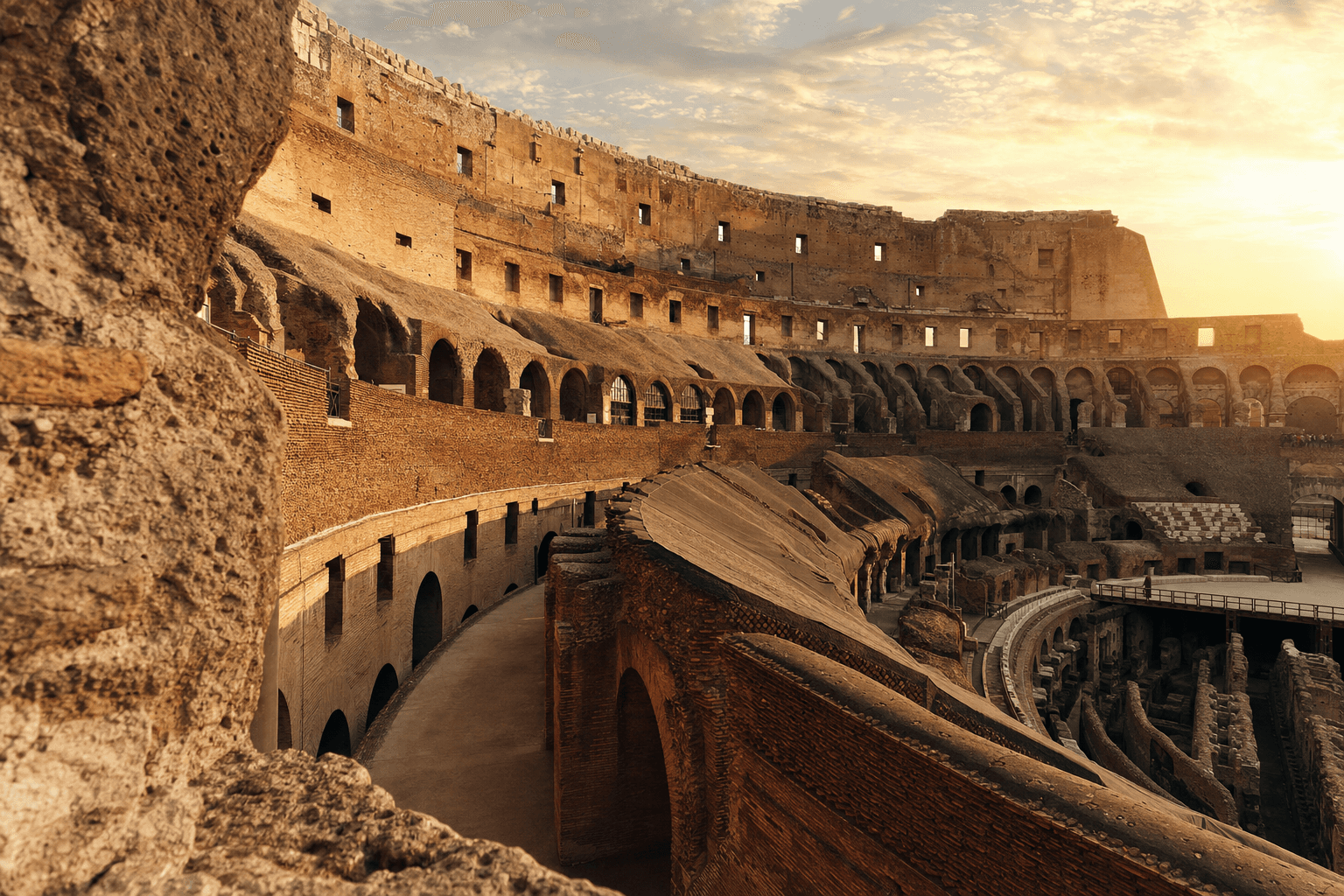
Learning how to buy Colosseum tickets is, for most visitors, the single most confusing part of planning a trip to Rome. The official system — run by the Parco Archeologico del Colosseo, the state body that manages the monument and its surrounding archaeological park — lists nine ticket types, releases inventory only 30 days ahead of each visit date, locks every ticket to a named person, and sells its most sought-after tiers out within minutes in high season. None of this is hidden, exactly. It is simply explained badly.
What follows is the decoder. The good news, stated plainly at the start: the standard ticket is inexpensive, and it is entirely possible to visit the Colosseum well on your own. What a guided visit adds is access certainty and interpretation — not the ticket itself.
Why the Colosseum sells out
Three mechanisms combine to make Colosseum tickets scarce, and understanding them explains almost every frustration travelers report.
The first is the release window. Tickets do not go on sale months in advance. They appear on the official site 30 days before the visit date, on a rolling schedule — so a visit on 20 May becomes bookable around 20 April. This means there is no way to lock in your Colosseum date the moment you book flights, and no advantage to trying.
The second is capacity. Access inside the monument is metered: time inside is capped by ticket type, generally 75 to 90 minutes, and the specialised itineraries carry hard limits on group size. The Attic tier — the upper level — runs on slots capped at eight people, which is why it disappears almost as fast as it appears.
The third is name-locking. Every official ticket is issued in the name of the person who will use it, and matching photo identification is checked at entry. This is enforced strictly, not as a formality. Name changes are permitted only under specific exceptions, and only up to seven days before the visit. The intent is to suppress resale and speculation, and it largely works — but it also means you cannot buy spare tickets "just in case" and decide later who uses them.
The practical result: Full Experience Underground tickets sell out within minutes in peak season. Standard tickets hold for days or even weeks off-peak, but in high summer they can vanish the same day they are released.
The ticket types that matter
Of the nine types listed, seven are relevant to general visitors. In practice, most travelers are choosing between three or four. Note that the monument is closed on 1 January and 25 December.
Standard 24h entry (€18)
The baseline ticket costs €18 for an adult, plus a €2 booking fee. Within its validity window it covers levels one and two of the Colosseum, plus the Roman Forum, the Palatine Hill and the Imperial Fora — the adjacent civic and imperial centre of the ancient city. For a first visit, this is a generous amount of ground for the money, and it is the ticket most people should buy.
What it does not include: the Arena floor — the reconstructed platform at the level where the games took place — and the Underground, the network of service corridors and lifts beneath it. Those require a Full Experience ticket. If arena floor access matters to you, the standard ticket will not deliver it, no matter how early you arrive.
Full Experience — Arena, Attic, Underground
The Full Experience tiers cost €22 to €24 plus the booking fee, and each adds one restricted area to the standard itinerary.
Arena: access to the floor of the amphitheatre, standing where the sand once was and looking up at the tiers as a performer would have. Attic: the upper level, with the widest view down into the bowl and out across the Forum. Slots are capped at eight people, which makes this the hardest tier to secure after the Underground. Underground & Arena: the most complete itinerary, valid across two consecutive days. The Underground portion includes a licensed guide assigned by the Park — a regulatory requirement rather than an upsell, since the substructures cannot be visited unaccompanied.
If you have one hour and one ambition, the Arena is the emotional centre of the monument. If you want the architecture explained by the building itself, the Attic is the more revealing choice.
Free tickets and reductions
Under-18s enter free, regardless of nationality — but they still need a named reservation, and the €2 booking fee applies to it. Do not assume a child can simply walk in with an adult.
EU citizens aged 18 to 25 qualify for a reduced rate: €2 on the standard ticket and €6 on the Full Experience tiers. Bring the identification that proves both age and citizenship, since the same ID check applies.
The Park also observes free-entry days — the first Sunday of each month, plus selected national dates. These come with real trade-offs. Tickets cannot be reserved online; they are collected on site, queues are long, and neither the Arena floor nor the Underground is accessible. For a traveler with limited days in Rome, paying €20 to walk in at a fixed time is usually the better use of the morning.
How to buy Colosseum tickets on the official site
Buy from ticketing.colosseo.it, the Park's own ticketing platform. It is the only source that sells at face value, and every other channel is reselling or bundling what it obtained there.
The method is straightforward once the rules are clear:
Count back 30 days from your intended visit date. That is roughly when inventory opens, on a rolling schedule — check the official site rather than relying on a fixed hour, since reports of the exact release time are inconsistent. Decide your tier before you sit down to book. If you want the Underground, you will not have time to deliberate. Enter each visitor's name exactly as it appears on their passport or ID card. Every ticket is name-locked and the document is checked at entry. Treat the purchase as final. Official tickets are non-refundable and non-reschedulable except in narrow, specified circumstances. Name changes are possible only under particular exceptions and only up to seven days out.
One more piece of planning discipline: fix your Colosseum slot before you build the rest of the day around it, not after. It is the least flexible reservation in the city — the Vatican has its own booking maze, but at least it releases inventory differently. If you are planning a Rome trip in 2026, the Colosseum date is the pin the other days hang from.
If the date you need is gone
This happens constantly, and there are honest options rather than tricks.
Move the date or the tier. The simplest fix is flexibility. If the Underground is gone for Thursday but the Arena is available Friday, take Friday. If every Full Experience slot has disappeared, the standard ticket still admits you to the monument and to the Forum and Palatine — an excellent half-day by any measure. Broadly, quieter months make everything easier: the same monument, the same ticket price, a fraction of the competition.
Check back. Because tickets are name-locked and cancellations are restricted, returns to inventory are limited — but they are not zero. Re-checking the official site in the days before your visit occasionally rewards persistence.
Consider a licensed operator's allocation. Tour companies and authorised resellers hold their own timed allocations, which is why a guided visit is often still available when the direct-sale calendar shows nothing. You pay more than €20, and what the difference buys is the slot, the guide and the certainty rather than the stone.
For travelers in that position, our Colosseum, Roman Forum & Palatine Hill tour covers the same three sites as the standard ticket with a licensed guide and a confirmed entry time — useful when the official calendar has closed, and useful when you would rather not spend your first morning in Rome deciphering a ticketing platform. If the Colosseum is one stop in a single ambitious day, Rome in a Day threads it together with the city's other essentials.
What the ticket doesn't buy
A ticket buys admission. It does not buy comprehension, and the Colosseum is a monument that withholds a great deal from the uninformed eye.
Without context, the interior reads as scaffolding and stone: a broken oval, a partial floor, a maze of brick walls below. What is missing is the explanation. That the vast brick substructure held animal cages, hoists and counterweighted lifts, and that the machinery worked. That the outer wall's absence is not decay but quarrying, its travertine carted off for Renaissance palaces and churches. That the tiered seating was a diagram of Roman society, with senators at the ringside and the poorest spectators highest and furthest away. That the building was later a fortress, a quarry, a Christian shrine, a botanist's field site — and that its afterlife is nearly as long as its working life.
None of this is obscure scholarship. It is simply not printed on the walls. Some visitors find it themselves through reading beforehand, and do so with real pleasure — that is a legitimate way to visit, and the €18 ticket serves it perfectly. Others would rather have a licensed guide translate the ruin in real time, ask questions as they occur, and leave with a coherent picture of the whole imperial centre rather than a set of photographs.
Both are good visits. The distinction worth being clear about is this: the ticket gets you inside a very large ancient building. Everything that makes it legible, you supply — from a book, from a guide, or not at all.